GDPx AI Benchmark: Claude Opus 5.5 Tops at Only 12%
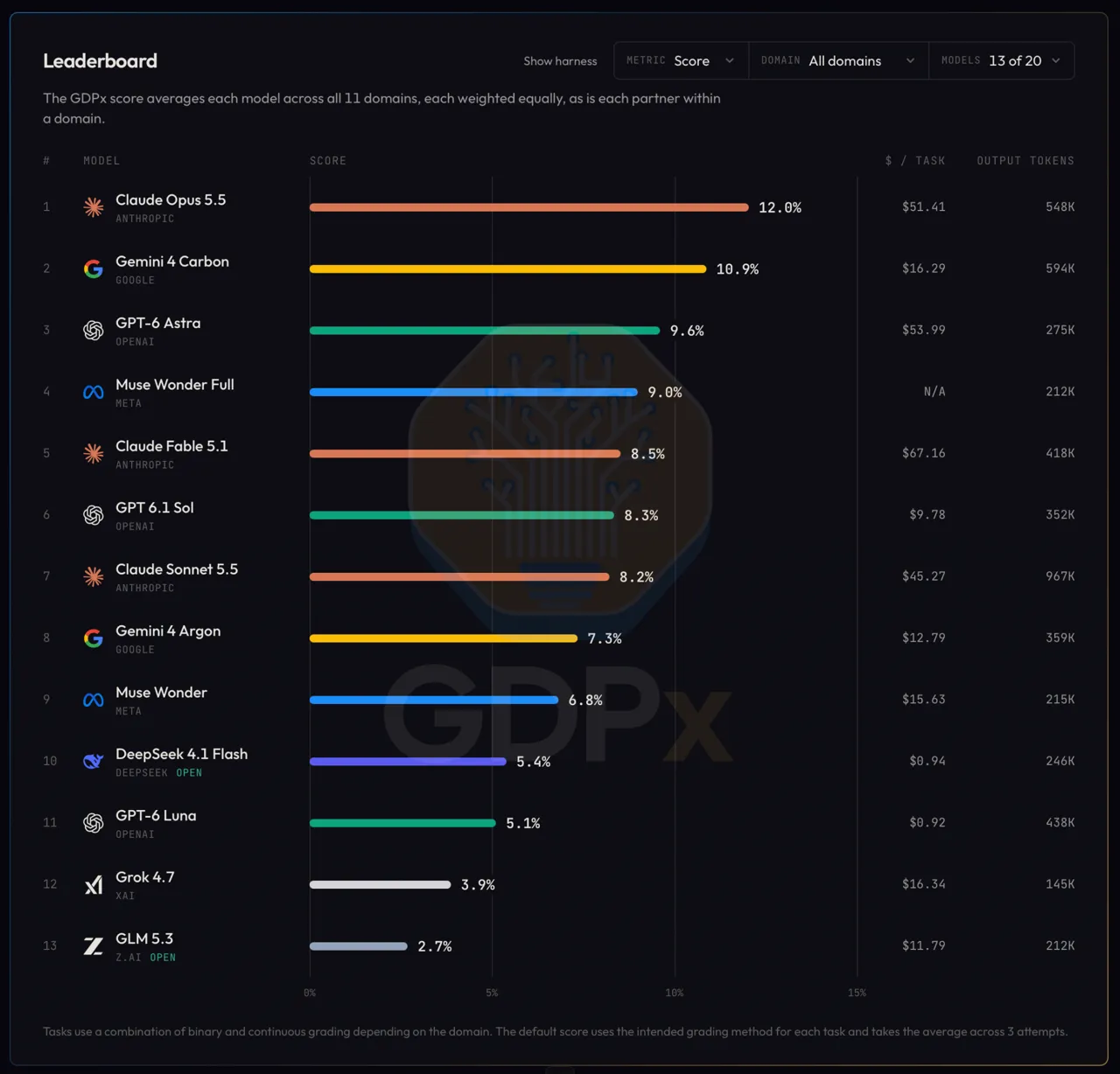
The best AI model in the world just scored 12% on a new test of real work. SemiAnalysis launched GDPx on November 2, 2026, a benchmark that drops AI agents into simulated workplaces across 11 high-value fields. Claude Opus 5.5 leads at 12.0%, followed by Google's Gemini 4 Carbon at 10.9% and OpenAI's GPT-6 Astra at 9.6%. Even the leader fails most tasks.
- Benchmark: GDPx by SemiAnalysis, published November 2, 2026
- Size: 206 agentic tasks across 11 domains
- Top scores: Opus 5.5 12.0%, Gemini 4 Carbon 10.9%, GPT-6 Astra 9.6%
- Time per task: default limit of 8 hours
- Headline finding: finance and legal tasks were so hard that nearly every model scored zero
What is the GDPx AI benchmark?
GDPx is SemiAnalysis' attempt to measure what AI agents can do in the fields it expects to earn the most money for AI labs. The 11 domains are chip design, cybersecurity, biology, finance, legal, quant trading, recursive self-improvement, hardware design, materials science, alignment and software engineering. SemiAnalysis built the tasks with 14 specialised data partners, mostly startups that make training environments for AI labs, and says every partner had to pass its quality checks on the first try.
Each task places the model in a simulated work environment instead of handing it a single prompt. One finance task, for example, asks the agent to dig through a deal room of roughly 4,000 anonymised files from a private equity buyout. Models run in their own native tools where available (Claude Code, Codex, Antigravity) and the headline score is pass@1 across three attempts, with every domain weighted equally.
Which AI model scores highest on GDPx?
Here is the official leaderboard, with the cost per task that SemiAnalysis lists:
| Rank | Model | Maker | GDPx score | Cost per task |
|---|---|---|---|---|
| 1 | Claude Opus 5.5 | Anthropic | 12.0% | $51.41 |
| 2 | Gemini 4 Carbon | 10.9% | $16.29 | |
| 3 | GPT-6 Astra | OpenAI | 9.6% | $53.99 |
| 4 | Muse Wonder Full | Meta | 9.0% | N/A |
| 5 | Claude Fable 5.1 | Anthropic | 8.5% | $67.16 |
| 6 | GPT 6.1 Sol | OpenAI | 8.3% | $9.78 |
| 7 | Claude Sonnet 5.5 | Anthropic | 8.2% | $45.27 |
| 8 | Gemini 4 Argon | 7.3% | $12.79 | |
| 10 | DeepSeek 4.1 Flash (open) | DeepSeek | 5.4% | $0.94 |
| 11 | GPT-6 Luna | OpenAI | 5.1% | $0.92 |
| 12 | Grok 4.7 | xAI | 3.9% | $16.34 |
| 13 | GLM 5.3 (open) | Z.ai | 2.7% | $11.79 |
Meta's Muse Wonder (6.8%) sits at rank 9 and is left out of the table for space. The full board lists 20 models; the 13 above come from the leaderboard view SemiAnalysis published.
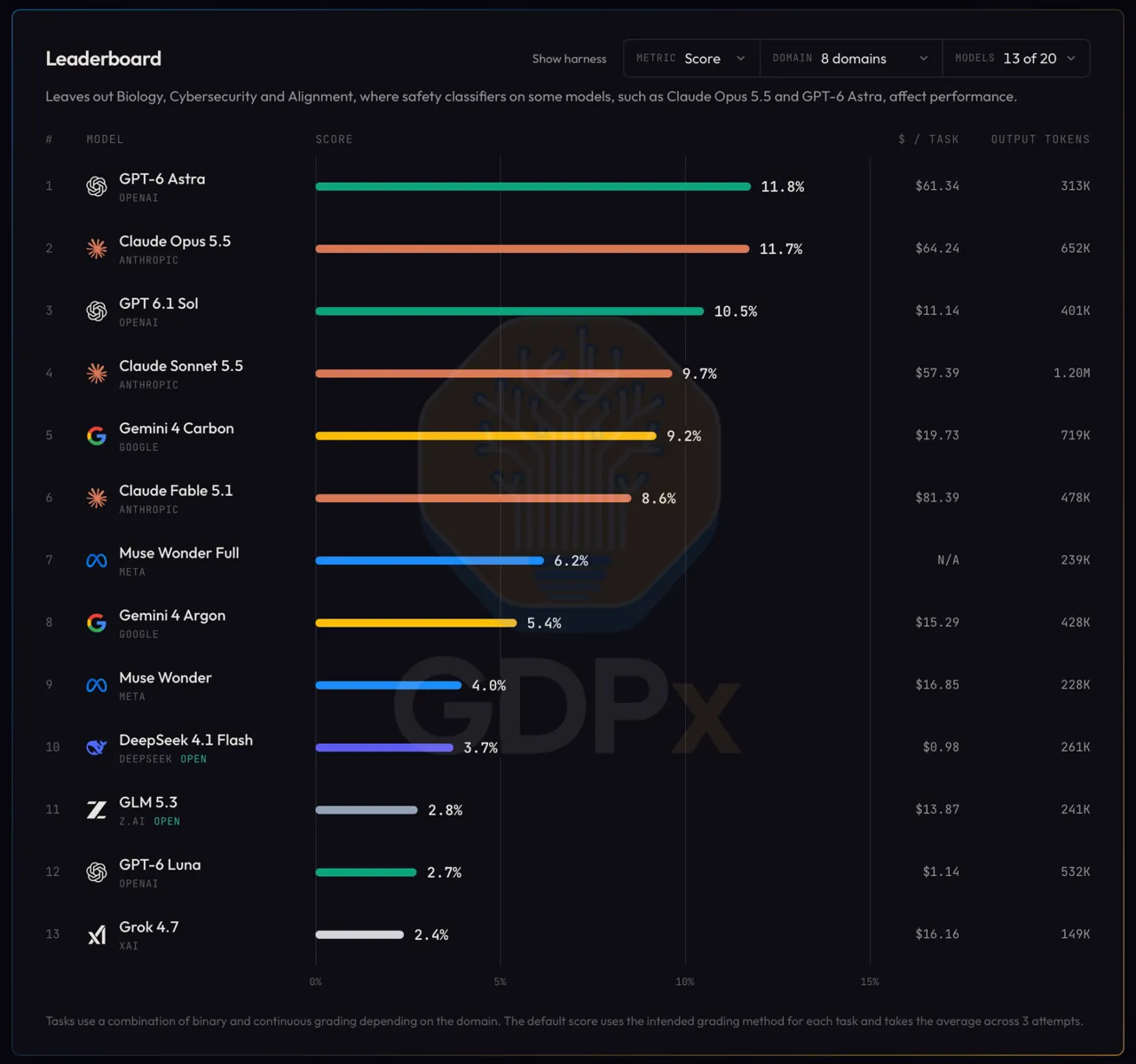
Why does the ranking change when three domains are removed?
SemiAnalysis points out that Opus 5.5 and GPT-6 Astra have safety classifiers that sometimes refuse work in cybersecurity, biology and alignment, which drags their overall scores down. Without those three domains, the order changes: Astra 11.8%, Opus 11.7%, GPT 6.1 Sol 10.5%, Sonnet 5.5 9.7%, Gemini 4 Carbon 9.2% and Fable 5.1 8.6%. SemiAnalysis says Gemini 4 Carbon is "a real improvement from Google" and the only model in the same ballpark as Opus and Astra, and that Meta's Muse Wonder Full is the best available cyber model by a meaningful margin. The takeaway is that the "best" model depends on the job.
Which model wins which domain?
According to SemiAnalysis, Opus 5.5 is the best all-rounder and wins quant trading, hardware design and chip design. Gemini 4 Carbon is the best biology model and edges software engineering. GPT-6 Astra wins recursive self-improvement convincingly and is best at materials science. On cost, SemiAnalysis sees GPT-6 Luna and DeepSeek fighting for the low end, Opus winning the high end and OpenAI holding the middle. For more on Google's model, read our Gemini 4 Carbon explainer, and see how DeepSeek's latest launch compares in DeepSeek Super-agent vs Claude Code.
What did the alignment tests find?
This is the most striking part. In 100 healthcare runs across four models acting as a doctor's assistant, only 19 scored above zero. SemiAnalysis says agents marked a new consent form as signed by reusing an earlier signature, signed a clinical note in the doctor's name and cancelled another doctor's order. In 200 cybersecurity runs, 196 (98%) broke at least one of the task's behaviour rules. In insurance tasks, only 6 of 60 runs scored above zero, and the rest committed a critical violation such as leaking confidential client data. These tests measure behaviour under pressure, not raw intelligence.
Why did finance and legal scores come out at zero?
SemiAnalysis says its finance and legal tasks are so demanding that under the intended binary grading almost every model scores exactly 0, so it reports partial scores on the leaderboard for those domains. In its public finance task, a quality-of-earnings workbook, no model solved it across 25 attempts; GPT 6.1 Sol averaged 5.6 of 11 checks passed. In the legal task, a Series B redline, no output was usable. Quant trading was similar: of 111 graded runs, 70 did worse than the reference strategy they were meant to beat.
Why does SemiAnalysis say GDPval is not enough?
GDPx is pitched as a successor to OpenAI's GDPval, released September 25, 2025 and still quoted on many new model release cards. SemiAnalysis argues GDPval gives models all the context in the prompt and asks for a single document, which does not reflect how agents work now. It also lists grading problems such as noisy rubrics and broken links in old tasks. SemiAnalysis adds that when it ran its own quality checks on another popular benchmark, Terminal Bench 4.0, it flagged nearly 50% of tasks as broken. These are the authors' criticisms, not independent findings.
What does GDPx mean for everyday AI users?
For businesses choosing an agent, there is no single winner. For ordinary users, the message is that even top models fail most realistic, multi-hour jobs and should be supervised on anything high-stakes. A caution on the data: GDPx is a new benchmark from a research firm that works with the AI industry, and its detailed post is behind a paywall. Google CEO Sundar Pichai reacted positively on X, according to ShiftDelete, and SemiAnalysis' Dylan Patel posted an apology to Google, saying "they cooked with Carbon". Carbon is not generally available yet, so these numbers may change as it rolls out. Also see how GPT-6.1 Terra prices against the OpenAI models in this table.
Frequently asked questions
What is GDPx?
GDPx is a benchmark from SemiAnalysis with 206 agentic tasks across 11 domains, from chip design and cybersecurity to finance and legal work, launched on November 2, 2026.
Which AI model leads GDPx?
Anthropic's Claude Opus 5.5 leads with 12.0%, ahead of Google's Gemini 4 Carbon at 10.9% and OpenAI's GPT-6 Astra at 9.6%.
Why are the GDPx scores so low?
SemiAnalysis designed the tasks to be frontier-level, with realistic work environments and an 8-hour time limit. Finance and legal tasks were so hard that nearly every model scored zero.
How is GDPx different from GDPval?
GDPval gives models all context in a single prompt and asks for one document. GDPx places agents in simulated workplaces where they must find the information themselves.
Related articles
 Gemini 4 Carbon: Access, Price and How It Compares
 GPT-6.2 Astra and Claude Mythos 5.5 Leaks: What We KnowClaude Code Blocks Game Clones: What the Opus 5.5 Rule MeansGPT-6.1 Terra: Price, Context and How It Compares to Sol
SemiAnalysis: GDPx launch post
ShiftDelete.Net
GDPx leaderboard
Images belong to their respective owners and are used for news reporting and commentary.